Thursday, January 3, 2019

#MustReadin2019

Happy New Year! 🎉🎉🎉

I was a first-time participant in Carrie's reading challenge last year, and I had so much fun! If you consider accepting the challenge, and are even a LITTLE bit like me, please mentally prepare yourself. You agonize over which books to choose...you commit to your list...you put it in writing...and then you look at other readers' lists and realize how many titles you overlooked. The horror! 😱. 

(I'm totally kidding. This is a fantastic way to get great recommendations from fellow readers and add titles to your wish list!)

My goal is to read one of these titles each month. With only two exceptions, I have read other books by the authors on my list, and I am extremely confident that my reading time will be well spent! 

 Born a Crime by Trevor Noah

 Children of Virtue and Vengeance by Tomi Adeyemi

 Genesis Begins Again by Alicia D. Williams

 Grenade by Alan Gratz

 Monday's Not Coming by Tiffany D. Jackson

 Odd One Out by Nic Stone

 On The Come Up by Angie Thomas

Pride by Ibi Zoboi

Rayne and Delilah's Midnite Matinee by Jeff Zentner

 The Remarkable Journey of Coyote Sunrise by Dan Gemeinhart

Two Can Keep a Secret by Karen M. McManus 

What If It's Us by Becky Albertalli and Adam Silvera

Saturday, December 22, 2018

#MustReadin2018 Winter Update


Hello, Readers! 📚
This is my final #MustReadin2018 update! I JUST got the last two books in under the wire. This was truly a "so many books, so little time" year for me. But I did discover some amazing titles!

I REALLY enjoyed One Of Us Is Lying by Karen M. McManus! Set in high school, five students show up for detention, and only four walk out alive. Lots of suspense! And JUST when you think you've got it all figured out...BOOM. 😕

They Both Die At The End by Adam Silvera gives a clue right on the cover that this book is not going to have a happy ending. What I will remember most  is wondering whether it would be good or bad to know your death date, and what would be the non-negotiables that I'd need to complete before the time was up.

The Peculiar Incident on Shady Street by Lindsay Currie is a FANTASTIC scary story!! Many of my students enjoy ghost stories, and I was so excited to introduce them to Tessa. Her family moves into an old house in Chicago, and creepy, goosebump-raising things begin to happen...crying, electric disturbances, things moving around...and then there's that ventriloquist dummy. 😱

I read The Vanderbeekers of 141st Street by Karina Yan Glaser this month, which was perfect because the story begins on December 20 and leads up to Christmas. The Vanderbeekers have been told that their lease is not being renewed and they need to move out by the end of the year. The kids decide that the answer to the problem is to make the landlord (AKA "The Biederman") like them. But will they have enough time??? This book celebrates family in all of its forms, and is a perfect read for the holiday season! 🎄

I absolutely LOVED Leah on the Offbeat by Becky Albertalli! Words cannot do an adequate job of describing how much I adore her writing. Leah's story is both moving and hilarious. For those who have heard me describe something as a big bag of suck, my favorite quote was, "Embrace the suck" (which, let's face it, is fantastic advice!). Ms. Albertalli perfectly depicts all the angst of senior year: pre-college jitters, high school disappointments, family, relationships, drama, and friendship. I highly recommend this book to everyone!

Granted by John David Anderson, is the delightful tale of fairy Ophelia Delphinium Fidgets, who has been tasked with granting a young girl's wish for a purple bicycle. There are MANY obstacles in her path, and some life lessons to be discovered. This book is also filled with little bits of wisdom like, "...even an old doughnut with enough frosting is better than most other things she could imagine" (163). On her journey, Ophelia meets Sam, the dog who has just become my new favorite MG character. My middle school students loved when I read aloud the part when Ophelia meets Sam for the first time. I'm ashamed to admit I almost missed this one because I put other books ahead of it, but this is definitely a title you should have on your shelf!


Many thanks to Carrie Gelson for starting #MustReadin2018 and encouraging me to work on my blog. 

I look forward to continuing my reading journey in 2019, and wish you all Happy Reading in the New Year! 📚


Sunday, November 18, 2018

Thoughts From The Book In Question by Carol Jago

This book is an immediate call to action for all educators, not just English teachers. 

Let's begin with the problem:

"...too many students are choosing not to read. As a result they are less informed, less articulate, and I believe less understanding of others" (14).

I agree, and immediately connected this to the work of Rudine Sims Bishop. Please click the following link to a short video in which she discusses the importance of reading diverse books:


Additionally, you may want to check out We Need Diverse Books.


Jago explains, "Fictional characters are invaluable facilitators of dialogue concerning delicate topics" (115). She specifically mentions the importance of reading books like The Hate U Give by Angie Thomas. I would recommend exploring any or all of the books on the Project LIT Community reading list.

"...the importance of working toward the goal of ensuring every child grows up to be an able and avid reader cannot be overstated" (25).

At the end of the first quarter, I surveyed my students at length about their attitudes toward reading. Needless to say, they don't all love it. I'm constantly inundated with, "all these books are trash," or "there's nothing to read in here." Further conversations have revealed that many were not given time to read books that they chose in earlier grades. Reading was mostly done for the purpose of answering questions. Is it any wonder that many students see reading as a chore, or something just "for school"?

So educators, what are we going to DO to change these negative perceptions of reading?

"While a well-stocked classroom library and a passionate reader-teacher are critical ingredients of a vibrant reading program, they are not enough. You need to create a culture of reading within your classroom" (28).

I believe that the culture of reading needs to be present within the entire school. Our staff publicly posts what we are reading, and have been challenged by one of our Library Media Specialists to read 1000 books during the school year. Our wonderful art teacher has made a visual representation of our progress and placed it near the cafeteria for everyone to see. But I don't believe what we're doing is enough. We need to TALK about our reading with students. I came back from a doctor's appointment and told my students about the book I finished while I was in the waiting room. One student asked, "Wait, you mean you really read, like FOR REAL?" I enthusiastically replied, "YES!" Our kids need to understand that reading is a LIFE skill. 

As I continue to reflect on this book it may lead to further writing, but I'm going to end this post with what I consider to be my personal call to action.

"We should be concerned about the large number of students who don’t read every bit as much as we worry about those who can’t" (10).


Monday, November 5, 2018

Why Is Book Access Important To You?

This question was posed to the participants of the #ProjectLITChat on Sunday, November 4. It was suggested that we might benefit from having all of the fantastic responses in one blog post. I accepted the challenge! 😊
If I missed your response, I sincerely apologize. 


  • Book access is important to me because students need to see for themselves there is more to reading than the books read in English classes. Access and choice build reading lives and validate what authentic reading really looks like. Students deserve access to that world. ~Christine Larsen
  • Book access is crucial, but almost as important is teachers/librarians showcasing titles. Kids looking at stacks and stacks of books can be overwhelming. Finding a way to hook kids on a title is how we'll keep them coming back. ~Jonathon Myers
  • Book access is important to me because it's an equalizer in our society. Everyone has the right to read and access information and ideas, not just the wealthy or privileged. ~Kelsey Collins
  • Students need access to books to increase literacy. Believe it or not, students are pretty shocked when I tell them they can request and have any book shipped from within a library system for free. That's empowering. ~Sidney Thomas
  • Book access is important because readers learn they're not alone in whatever struggle sets them apart. Characters and settings like themselves can be found between the lines of the stories recorded in books.
    ~Joy Barnes-Johnson, Ph.D.
  • Book access important to me because poverty keeps people bound. Books, especially from classrooms and libraries in print and digital forms allow people to experience other worlds at the low, yet valuable cost of time. ~Joy Barnes-Johnson, Ph.D.
  • Book access is crucial, as it can give students a representation of life/the world. The more diverse the library, the more accurate the representation. ~Basil E. Frankweiler
  • I enjoy watching a young reader disappear into the work of the writer as both unite as one. Book access helps me sustain that enjoyment. The more books, the merrier. ~Manuel Garces, Jr.
  • Your classroom library should reflect your current students, so book access is everything. You want your students to be reading material that represents them, intrigues them and makes them wonder. ~Monika Moorman
  • Books save lives. Students silently deal with so much doubt, pressure, and trauma. Books are a reminder that they are not alone. Also, books just make us better humans, no? ~Isabel Morales
  • Book access is just the beginning, then we need to give everyone time to read and time to talk about what they've read. Talk--not complete worksheets--but have conversations, book chats, book blessings, chat-chat-chat! ~Kris McGee
  • When I think about book access, I think about my young readers, but I also think about my preservice teachers I teach. They need access to books too, just like our inservice teachers do. Readers become stronger by reading. ~Kris McGee
  • As a librarian, book access is at the heart of what I do! I want my students to have access to all kinds of stories offering both windows and mirrors and find their passion for reading! ~Shannon DeSantis
  • Book access means a chance to learn about one's self and the world. I also link it to freedom. ~Sarah Williams
  • Books are powerful. Every student deserves access to the ticket that a book holds. This ticket can not only transport a reader into a magical world, but it can also teach empathy, and reiterate the idea that you are not alone. ~Tyler Sainato
  • People need to be able to have books--not just any book, but relevant and interesting ones. Many times it's not the lack of desire to read, but the lack of resources which prevents reading. ~Tracy Mitchell
  • Book access creates community, inspires wonder, and is foundational in the work for equity in education. ~Dan Dooher
  • Book access is important because the stories young readers need are often restricted, or not available to them. ~Teresa Easterling, M.Ed.
  • Students aren't always exposed to the subjects, people, professions, mentors, attitudes, optimism, and other traits they need to create a successful life for themselves. Having access to books and stories that guide them and help them cope can be lifesaving. ~Brandy Sue Alexander
  • Book access is access to lives. ~Clint Whitten
  • Book access is everything! The only way I know to create authentic readers is to provide books that speak to real teenagers. There is no universal book that fits everyone, so we must have access to MANY books. ~Lynn Hagen
  • All kids should be flooded with great books, period. We know how impactful it is to have good books at your fingertips and so it should be a right for all; not just the lucky, the privileged, the wealthy, or the kids with "high enough test scores." ~Ashleigh Rose
  • I truly believe that fiction books are crucial in building empathy and allowing readers to imagine themselves in worlds other than their own. Everyone deserves access to different perspectives. ~Miss Rachel CY
  • Book access is central to literacy, which is fundamental to equity. ~90-Second Newbery
  • If we want students to become expert learners we need to help them find all the ways to do so. Book access is at the top of my list. The more tools we can put in their hands the better learning and living can be. ~Kelley Culp
  • We can't expect our students to read if we don't give them access to great books! ~Jennifer Green
  • Providing students with access to books that are interesting to them gets them wanting to read. I don't know how many students have told me this it the first they're read a book in a long time. ~Saral Gillman
  • Book access is important because it allows all students the opportunity to read, learn, and experience life. ~ELA with Urquhart
  • Books have the power to change and save lives. And despite what MI courts may say, literacy IS a fundamental right for ALL people. ~Jessica Sherburn
  • As a librarian, book access = the heart of our profession. If we're doing it right, book access means access to books--a flood of books--that reflect our students, their interests, and their lived experiences. Books save lives. Books save all of us. ~Julie Stivers
  • I'm finding that my students are reading much more now that I have a constant supply of amazing books available that they want to read. Access makes kids readers because they are within reach when the desire strikes, and it's not an extra effort. ~Molly Castner
  • The only way to foster a love of reading is to have access to books that interest students. ~Dr. C. Tennyson
  • I believe limiting or eliminating access to books that are culturally sustaining is a deliberate move that affects lives and futures in ways that ultimately impacts society as a whole. ~Julia E. Torres
  • Book access is important to me, because I believe that reading is transformative. Kids just need time to read and access to great books. ~Nicole Russell
  • Book access is important because if we do not flood our students with text, if we do not make it easy, if we do not make it accessible, it is easier to just not read, and not have your life changed by wonderful stories. And that would be a shame. ~George Evans
  • Reading is important. Period. We have to bring back the love of learning. Because of Project LIT book selections, I have been able to hook students into reading again. ~Sara Devine
  • Book access leads to literacy and engagement, empathy and an opening of horizons, revealing what is possible, and creating conversations. Storytelling is universal. ~Derrick Schellenberg
  • Book access should lead to book choice, with students empowered to inquire into current topics and author styles of interest to them. Kids should be subjected to a wide variety of types of texts and engage in reading levels that meet them where they are. ~Derrick Schellenberg
  • Book access is important to me because ALL students deserve to be surrounded by quality books they can use as mirrors, windows, or doors. As a teacher, I can help make sure my students have access. ~Sarah Levy
  • Book access to me means choice. The more books students have access to, they will more likely find that book that "speaks" to them, or the book that hooks the reluctant reader. It also opens students to worlds beyond their own. ~Dayan Shannon
  • Book access is important to me because I know how much I use books as part of my own emotional story. Everyone deserves access to tools that help them feel all the feels. ~Mrs. Schimizzi, NBCT
  • Book access is important because I want reading to compete with video games and sports as entertainment and not just something you do in English class. Build the knowledge and skills while being entertained and kids will do it. Make it hard, and they won't. ~Amanda Kremnitzer
  • Acknowledging book access (or lack thereof) demystified the struggle my kids were having with reading confidence. Once I updated my library and provided MEANINGFUL texts for my kids, reading was no longer a battle. Kids will read a book if it matters to them. ~Zaz the Teacher
  • Everyone needs to see himself/herself/themselves in books AND others need to learn about them. Then we all need safe spaces to talk about them. ~Veronica B Dougherty
  • Book access is such a huge deal on so many levels: building empathy, bridging learning gaps with powerful reads, ensuring our students have an escape with reading, etc. Just always want to get those great reads in their hands! ~Mrs. Criswell
  • (Book access is important) because my choice of learning is limitless. It has grown my vocabulary, my questioning, my beliefs, etc. ~Barbara Page, M.Ed

Wednesday, July 18, 2018

180 Days

Summer PD continues! I've just finished 180 Days by Kelly Gallagher and Penny Kittle. Secondary English teachers, this one is for YOU!

The book covers the authors' core beliefs and daily practices, their mapping of reading and writing for the year, how they balance feedback and evaluation, and how they teach different writing discourses.

If you happened to be nearby as I was reading, you heard frequent cries of "AMEN!" and "PREACH"! If you look at my book, you'll see annotations including "YES!" and "We do this in education ALL THE TIME!" When a friend (and former colleague) asked me what it was that made this book such a must-read, I said, "It's giving me validation about my teaching practices. But mostly, the authors have the courage to say the things that I want to say."

Let me begin with this quote:
"Reading and writing in school is rarely practiced as the life-sustaining force it is. Students leave one year after another having missed the personal joy, the satisfaction, and the power of creating their own canon of books they love and pieces of writing they cherish" (5). 

In June, I completed my 11th year teaching a middle school reading intervention class, and this quote is absolutely true of my students. These kiddos do not come to me with the "contagious passion" for reading that Gallagher and Kittle hope to create. Instead, many of them have been forced to complete reading strategy worksheets in lieu of reading and responding to authentic texts. When I ask students at the beginning of each year to name a favorite book or author, many can't (this was something that the authors noted in their high school classrooms as well). My most frequent answer to that question is always "Dr. Seuss." When I think of all of the outstanding middle grade literature that they are missing out on, it makes me want to cry...but I'll save that for another post. At the middle school level, I have personally witnessed the removal of whole-class novels in favor of short texts or passages followed by multiple-choice assessments. Will these types of activities show us if students can choose a main idea or theme from a limited number of choices? Sure. Will they encourage and enable student creativity? Not even a little bit.

I viewed these two quotes as personal calls to action:
"We believe that as English teachers we must be readers and writers because it is the heart of our content area" (11).

"Many of our students come to us as dormant readers after a summer, or in too many cases, after years of reading only excerpts and short texts, not books" (12). 

Just as I do in my own classroom, the authors have piles of books on the desks/tables beginning on DAY ONE, and encourage students to shop for titles that interest them. The authors also complete Book Talks (one each class period, but with more titles mentioned the first few days so students can see what is available to them). 

A new idea that I want to put into practice is to have the students get started in their writing journals on DAY ONE as well. Starting both of these on the first day of school cements the expectation that when you walk in our door, you are readers and writers (my classroom door will have a similar sentiment on it very soon).  

I could write an entire post about the portions of the book that cover writing instruction, but as I read, one thing became clear: I need to up my game! The authors begin the year with Narrative writing because it is "central to all writing discourses..." (138). I too believe that the best way to ease kids in is to have them write about themselves. 

According to 180 Days, the essential elements of writing are:
  • generating ideas
  • organizing and revising ideas
  • fine-tuning
These elements remain the same whether we are asking students to write a story or scene, or an informative or persuasive piece. 

My favorite "PREACH!" moments happened when the book discussed the dangers of writing to a "formula". This is a major sore spot for me. I don't believe we should EVER force all students to use the same writing template (Note: When a student requires additional support, then by all means, let's use a scaffold. But not all students are going to need it!). Instead, let's teach them to "read like writers" by having them "write beside" beautiful passages from mentor texts. That, of course, necessitates that our students read every day. 😉

While Mr. Gallagher and Ms. Kittle see their students for varying lengths of time, whether every day or every other, their breakdown of daily practice is the same. EACH DAY, the students:
     1. Read
     2. Write
     3. Study
     4. Create
     5. Share

I am so excited to use the ideas from this book to improve my teaching! More than anything else, my personal goal is for my students to find JOY in reading--to view it as something they GET to do, rather than HAVE to. The authors stated, "If current practices were effective, more students would love to read and write outside school" (223). 

Challenge accepted. 😊
Saturday, March 10, 2018

#MustReadin2018 Spring Update


Hello, Readers! 📖

I just thought I'd write a quick update on the books I've finished from my #MustReadin2018 TBR list. 

Passionate Readers by Pernille Ripp outlines exactly what I want my classroom to look like! I wrote an entire post about it earlier, so I won't say any more here, except that you really need to read this one!
My Goodreads review: This book is an absolute must-read for creating a reading community...with ideas and resources that teachers and admin can implement immediately. 🌟🌟🌟🌟🌟

The 57 Bus by Dashka Slater is a tough, but important read; a true story of an afternoon bus ride home for two teens in Oakland, CA. Richard and his friends are playing with a lighter, and Sasha's skirt ignites. Needless to say, a lot of lives are affected by this event. What I like most about this book is that the author deeply examines both sides of the story. The numbers offered about US juvenile incarceration are quite sobering. 
My takeaway quote: "'To forgive, you have to forget,' he counseled. 'Because otherwise you haven't truly forgiven.'"

I checked out Insignificant Events in the Life of a Cactus by Dusti Bowling from our school library. I read it, book-talked it to students, sketchnoted it, and then bought my own copy because it was a necessity for our classroom library. Aven has so many talents including art and playing the guitar. And she has a special gift for storytelling, which she mainly uses to explain what happened to her arms. I adore Aven's sense of humor, and the people she meets and friends that she makes are so wonderful. This book has family, friendship, mystery and a LOT of laughs. It is a beautiful reminder that people are so much more than what we see on the surface. I highly recommend this one!

I must admit, I don't usually read about superheroes. But I was pleasantly surprised by Miles Morales: Spider-Man by Jason Reynolds. I did a book talk on this one, and it was snatched up immediately by several different students. Miles is a character who is easy to relate to. A lot of our students dread going to one class or another, but Miles seriously dislikes his history teacher. There are several reasons for this, but mainly it's because Miles's spidey-sense goes into overdrive every time he is near! This story has a little of everything--the best friend, the love interest, the family issues, and a whole lot of drama and adventure. Once again, Jason Reynolds does not disappoint!

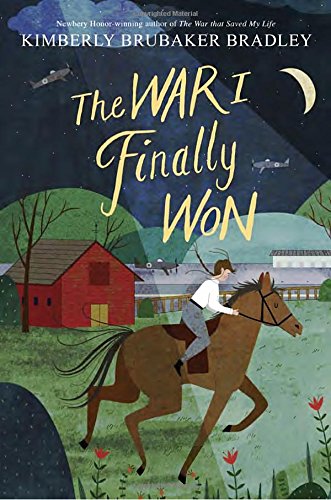
I have nothing but love for The War I Finally Won by Kimberly Brubaker Bradley! This is a continuation of Jamie and Ada's story from The War That Saved My Life. Shaped by the cruelty of her mother, Ada grew up so much faster than she should have. Now Susan is trying to teach Ada that it's OK to let someone take care of her for a change. When Ruth, a German girl, comes to stay with them, Ada struggles to understand faith, family, and making the right choices. I highly recommend both books!
I have never read a book by Katherine Applegate that I didn't like! Wishtree hit me right in the feels. The story centers on Red, the gorgeous old oak tree who watches over the neighborhood. Once a year, people visit Red to make their wishes and tie scraps of cloth to the branches. When a new little girl moves in with her family, her wish becomes a call to action for Red and the neighborhood animals. But what can they actually DO? This is such a sweet story!

I knew from the first sentence that I was going to enjoy I Am Not Your Perfect Mexican Daughter by Erika L. Sanchez. The title pretty much explains the book. Julia's sister Olga has died, leaving Julia to try to fill her shoes. Unfortunately, Julia's plans don't include living at home and going to college locally, and this is a major source of stress. As the story goes on, Julia discovers some new information about her family that makes her realize that not everything is what it seems. If I were going to summarize this story with an adage, it would be this one: "Everyone you meet is fighting a battle you know nothing about. Be kind."


I look forward to many more great titles this year!
Happy Reading! 📚


Thursday, February 15, 2018

On Behalf Of My Middle School Students

On any given day, how much time do you spend completing multiple choice assessments? Me...not so much. This got me thinking about how much time our students spend completing them. (Spoiler alert: it's a LOT!!!)

Unfortunately for far too many of our students, this has become the lens from which they view "reading": 
1. Read the passage. 
2. Read the questions that go along with the passage.
3. Select the best answers. 
4. Move on to the next passage. 

If that was all that "reading" had offered me, I guarantee you that I would not be the person (or Reading Specialist) that I am today. 

My love of reading may have started at home, but it was nurtured both at school and in the community...the public library Bookmobile that came to our grocery store plaza, the weekly class visits to the school library (it was a "special" like Art and PE), and my absolute favorite...when the BOOK FAIR came to school!!! 
(Sidenote: our school's Book Fair begins on Feb 26, and I'm still just as excited now as I was back then. 🎉🎉🎉) 

Sadly, the VAST majority of my reading intervention students do not share my book love. I think it's because of how they have learned to view "reading". When I say, "Let's get our books out and read!", I'm often met with the same reaction I would get if I said, "Let's poke ourselves with sharp sticks!" But I refuse to give up. An educator on Twitter once referred to middle school as "the place where reading goes to die". Not on MY watch, friends.

On behalf of my middle school students, I ask you to please consider the following.

1. A teacher reading aloud from a book while students follow along in their own copies is not a waste of instructional time. 

2. A teacher giving a book talk, then reading aloud a few pages to entice the students to want to read the book, is not a waste of instructional time.

3. A teacher reading a picture book to middle school students is not a waste of instructional time. As I've told my students, sometimes you have to be older to really appreciate the author's message. 

4. A teacher giving students class time to read and discuss books that they CHOOSE is not a waste of instructional time.

We MUST ensure that our students are spending time IN SCHOOL reading books. Not excerpts of books...books. We can't allow our fear that some students won't make good decisions keep us from giving all students the gift of reading time.


#MustReadin2020 Fall Update

#MustReadin2020 Hello, fellow book lovers! 📚💗 While I know that some people found reading extremely difficult during the pandemic, ...